Milestone Planning and Research · Engineered AI Systems
RΛTIO
AI Consulting, Coaching and Training · Data Science & Project Management Orientation
Project Quality & Risk Management
Your AI systems are engineered statistical-probabilistic systems. Who is building, verifying, and governing them?
RATIO works with organizations to engineer, audit, validate, and govern probabilistic AI — with primary emphasis on risk management, testing, and project governance. Backed by a rigorous, practitioner-tested body of knowledge aligned with the NIST AI Risk Management Framework.
Independent Audit · Certified Standards · Human Accountability · Building Competitive Advantage
The Stakes
Your AI is making
consequential decisions.
The governance infrastructure has not caught up. And the practitioners you are relying on may not have the verified, attested trustworthiness that consequential AI deployment requires. That gap is your liability. The structural solution is Trust ∝ 1/Risk: build the trust architecture, and residual risk falls proportionally. Build it with assessed risk management competency embedded at each occupational level, and residual risk falls on two channels simultaneously.
💸
The Cost Trap
"We spent real money on AI. I can't tell you what we got for it — and I can't tell you how much to trust it." 90% of executives report zero measurable productivity impact from AI deployment.
🎭
Confidently Wrong
In a pre-registered field experiment with 758 BCG consultants, workers using AI on tasks outside its capability frontier scored 19 percentage points worse than those working without AI at all. Inside the frontier, AI helps. Outside it, workers couldn't tell the difference — and deferred anyway. (Dell'Acqua et al., 2023)
❓
The Accountability Gap
"We shut off the AI forecasting tool — we could not explain to the CFO why it recommended what it did." No audit trail. No accountable human. No validation.
"A probabilistic system can degrade gradually without triggering any error. There is no equivalent of a runtime exception. Governance must come from outside the generative system."
THE GÖDEL-TURING CONSTRAINT · OCC §1.2
What RATIO Does
From vision to deployment —
and the people who lead it.
RATIO works with organizations at every stage of the AI lifecycle — identifying value propositions, governing the build, validating the system, and developing the executive and team capability to sustain competitive advantage. Six integrated service lines. One standard throughout.
SERVICE LINE 01
AI System
Audit & Testing
Pre-deployment · Ongoing · Incident
Independent structured review of AI systems before deployment and throughout their operational life. We apply the OCC 5C framework — Consistency, Coherence, Contradictions, Confabulation, Calibration — across both automated scripting and irreducibly human gestalt review. Every audit produces a WoE verdict: PROCEED / INFO / WARN / FATAL.
Pre-Deployment Audit
OCC-5 gate review before any production deployment. No FATAL or WARN issues unresolved.
Ongoing Regime Monitoring
Continuous drift detection. Systems that passed yesterday can fail when the world changes.
AI Type Classification
LLMs, ML classifiers, Bayesian systems, and agents each require distinct audit protocols.
Confabulation Probing
Structured detection of outputs that sound authoritative but lack any deterministic computation layer.
SERVICE LINE 02
Competency
Validation
Individual · Team · Organization
Structured validation against the OCC Organizational Cognitive Competence matrix — the only framework that differentiates what AI users, AI reviewers, and AI governance authorities each need to know and demonstrate. Three tracks. Measurable outcomes. Defensible credentials.
BRANCH A
AI Users
Confabulation recognition. 5C output review. Scope-of-validity assessment.
BRANCH B
AI Reviewers
Gestalt audit protocol. Hybrid cognition architecture. WoE verdict authority.
BRANCH C
Governance Authority
Accountability chain design. FATAL escalation. Board-level AI risk translation.
SERVICE LINE 03
Governance
Architecture
Design · Implementation · Readiness Rating
End-to-end AI governance design for organizations deploying AI at scale. We build the accountability chains, escalation logic, human override architecture, and regime-change detection that transforms AI deployment from liability into defensible competitive advantage. Engagement concludes with an organizational AI Governance Readiness Rating.
OCC Lifecycle Integration
Human authority gates at every stage from business need through post-deploy monitoring.
Hybrid Cognition Design
Deterministic computation layer + LLM interpretation layer, each assigned by failure risk.
Board-Level Reporting
Translating probabilistic risk into language audit committees and CFOs can act on.
AI Governance Readiness Rating
Scored organizational assessment against the OCC standard. Documented. Defensible.
SERVICE LINE 04
The Executive
AI Laboratory
Guided Executive Program · 8 Sessions · By Request
A guided laboratory series for executive sponsors — walking the complete AI project lifecycle using live enterprise systems built and operating at Milestone Planning and Research. From identifying value propositions through deployment and governance. 30 minutes every Tuesday at noon CT. Complimentary for qualified executives.
Live Enterprise Systems
RAG, IUVO™ forecast, PRIMMS-GPT, and agentic systems — all demonstrated in real time every session.
Full OCC Lifecycle
Value propositions, requirements, build, testing, validation, agents, deployment, and governance — in sequence, with live tools.
Executive Sponsor Focus
Designed for the executive who funds, governs, and champions AI projects — not for developers. No technical background required.
Complimentary · By Application
Selective enrollment. Every application reviewed personally. Accepted applicants receive a recurring Teams invite for all 8 sessions.
SERVICE LINE 05
Executive &
Team Coaching
Individual · Team · Leadership Group
Hands-on coaching for executives and their teams navigating AI strategy, project sponsorship, and governance responsibility. Grounded in the OCC competency framework — practical, direct, and focused on building the judgment and capability that drives value and competitive advantage through AI.
EXECUTIVE
Sponsor Coaching
One-on-one coaching for senior leaders sponsoring AI initiatives. Strategy, governance posture, board communication, and decision authority.
TEAM
AI Project Teams
Coaching for the teams building and operating AI systems — OCC competency development, hybrid cognition practice, quality gate discipline.
LEADERSHIP GROUP
Cross-Functional Alignment
Facilitated sessions aligning executive sponsors, project leads, and governance authorities on accountability, scope, and value delivery.
SERVICE LINE 06
AI Innovation With Trust
& Trusted Innovation Capital
Know · Do · Become
RATIO builds the organizational capacity to innovate responsibly with AI — not just to use it. Technologies can be purchased. Consultants can be hired. Trusted Innovation Capital is different: it develops gradually through supervised practice, mentor/coach–practitioner thinking partnerships, and observed judgment under real-stakes conditions. It cannot be purchased. It can only be built. The AI Innovation With Trust Program is the institutional mechanism for building it — five occupational pathways, nine Common Trunk competencies, and a qualification card that attests what a practitioner demonstrated in real work, not what they were taught.
Executive & Sponsor Coaching
One-on-one coaching for senior leaders sponsoring AI initiatives — strategy, governance posture, and decision authority grounded in real accountability.
Mentored OJT Programs
Structured on-the-job learning with qualified mentors and journeyworkers. Practitioners build a portfolio of verified real-work deliverables — not simulations.
Five Occupational Pathways
AI Analyst · Ops & Governance Specialist · Quality & Validation Specialist · Developer · Business Process Architect. Each pathway mapped to business value.
Know → Do → Become
The program's core architecture. What the practitioner understands, what they demonstrably produce, and what professional judgment they exercise — all three assessed against evidence standards.
The Hidden Risk
The default answer is
the average answer.
There is an architectural fact about language models that the vendor community rarely states clearly.
A language model is trained to predict the statistically most probable next token. At default settings it converges on the modal response — the average expert's answer, the consensus view, the most common solution in its training data.
That is a reasonable baseline. It is not a competitive advantage. By construction, it is the same answer every other organization using the same model is receiving.
The right answer for your specific situation may not be the most statistically probable one. It may require domain knowledge that contradicts the published mainstream, or a solution that lives in the tail of the distribution — not at its center.
THE CONSEQUENCE
When every organization deploys the same models and accepts the modal answer by default, the industry converges toward the mean. Technology that was supposed to create competitive advantage instead produces competitive homogeneity. Everyone gets the same answer. No one differentiates.
THE RATIO RESPONSE
The RATIO methodology tests whether the model's output is the right answer for your specific situation — not just the most probable answer in the training distribution. That is the operational difference between a modal response and a validated one.
AI Governance Standards · NIST AI RMF 1.0
The NIST AI RMF defines
the destination. We provide the map.
The NIST AI Risk Management Framework (AI RMF 1.0) names the problem precisely: organizations deploying AI need structured governance, documented accountability, validated performance, and ongoing monitoring. What it does not provide is the operational methodology to actually do those things. That is what RATIO delivers.
RATIO operationalizes the NIST AI RMF's four functions — translating high-level governance principles into working audit procedures, accountability chains, review gates, and documented controls your organization can defend to a board, a regulator, or an audit committee.
GOVERN
Executive accountability structures, role definitions, escalation logic, and risk culture — built to hold under audit scrutiny.
MAP
AI system inventory, use-case risk mapping, stakeholder impact analysis, and capability boundary documentation — so you know what you actually have.
MEASURE
OCC-5C validation testing, calibration review, confabulation probing, and drift monitoring — producing documented WoE verdicts, not subjective assessments.
MANAGE
Prioritized risk controls, human override architecture, remediation workflows, and post-deployment regime monitoring — so governance continues after launch.
The NIST AI RMF is explicitly non-prescriptive — it defines outcomes, not methods. RATIO provides the operational methodology: the OCC audit standard, the WoE verdict system, the human accountability architecture, and the competency framework that make those outcomes achievable and defensible. RATIO is not affiliated with or endorsed by NIST.
The Foundation
Not a framework
borrowed from software QA.
A body of knowledge built specifically for probabilistic systems — from first principles.
10+ books, papers, and practitioner frameworks
▸
The Inductive Enterprise — Monographs 1 & 2
▸
OCC QA Methodology — AI Competency Program
▸
Hybrid Cognition Framework
▸
Applied Bayesian Analytics — WoE Methodology
▸
IUVO™ Forecasting System — AI in Production Case Study
The Deming era assumed repeatability. AI does not.
Every output is unique — not repeatable
Six Sigma reduces defect rates over time. AI quality must be verified before every consequential use.
Errors are plausible, not visibly broken
A confident wrong answer becomes your answer. There is no runtime exception for confabulation.
Systems cannot audit themselves
The Gödel-Turing constraint: oversight must be external, structured, and human-accountable.
Failure is regime-dependent
90% accuracy in training can become systematic failure when the world shifts. Ongoing monitoring is not optional.
Case Study · Live System
IUVO™ Forecasting System
A complete AI business process — from raw data to board-level output — demonstrated, audited, and used as a training vehicle for every RATIO service.
IUVO™ is a live S&P 500 narrative leading indicator and forecasting system — a full-stack probabilistic AI application running weekly in production. It ingests thousands of news headlines, converts them into narrative quantitative signals via WORDSTAT, builds a multi-model ensemble forecast, and produces a governance-ready output with a human analyst review layer.
It is not a toy or a classroom exercise. It is an operating AI business process — which makes it the ideal vehicle for demonstrating what rigorous audit, validation, and governance actually look like on a real system.
IUVO™ is also an outstanding working example used throughout the Executive AI Laboratory. It demonstrates how an autonomous system — driven by text input, hybrid cognition, and sophisticated prompt engineering — can produce actionable insights and serve as the foundation for effective managerial control systems. At the same time, it illustrates an important limitation: narrative-based inputs can carry bias and expose the system to other vulnerabilities. Prompt engineering that enhances system intelligence also opens a potential attack surface — internal misuse and nefarious manipulation of prompts represent real organizational security risks that must be mitigated by design, not assumed away.
THE SYSTEM ARCHITECTURE
01
WORDSTAT Narrative Pipeline
Headlines → narrative quantitative signal → PC-1 narrative composite factor. Deterministic computation layer.
02
M7 Ensemble Forecast Model
Inverse-MSE weighted ensemble of 6 models. 92.4% directional accuracy. Stata + statistical layer.
03
Early Warning Index (EWI)
Regime stress monitor. AMBER+ alert fires at 58.3% PPV — 17× lift over base rate. Human override gate.
04
LLM Interpretation + Analyst Layer
Hybrid cognition architecture: deterministic Stata output interpreted by Claude + human analyst gestalt review. No confabulated numbers.
USE 1 · DEMONSTRATION
Live Audit in Action
Every RATIO executive briefing includes a live OCC 5C audit of IUVO™ — not a hypothetical, but a real system producing real outputs this week. Executives see exactly what a confabulation probe looks like, what a WARN verdict looks like, and what a cleared audit looks like on a production AI.
USE 2 · ANALYSIS
Real Findings, Real Verdicts
IUVO™ operates under continuous OCC audit — including documented WARN findings, scope-of-validity flags, and analyst override decisions. These findings are real governance decisions made in production. Clients see the full chain: finding → verdict → resolution → deployment gate.
USE 3 · TRAINING
Validation Practicum
OCC Branch validation training uses IUVO™ as the practicum environment. Trainees apply the 5C protocol to real outputs, issue WoE verdicts, and practice the gestalt review against a system with known characteristics. Validation is earned, not just studied.
THE IUVO™ AI BUSINESS PROCESS — END TO END
01
Headlines
News data ingested daily
→
02
WORDSTAT
Narrative → signal
→
03
Stata Models
M7 ensemble forecast
→
04
OCC Audit
5C checks, WoE verdict
→
05
LLM Layer
Narrative interpretation
→
06
Analyst Review
Human gestalt gate
→
→
Published
Weekly governance output
See the live system — updated weekly.
The IUVO™ forecast is the public-facing output of the IUVO™ system, published every Friday.
Executive Education · Available by Request
The Executive AI Laboratory
An 8-session guided laboratory for executive sponsors. Walk the complete AI project lifecycle using live enterprise systems. 30 minutes per session. Complimentary for qualified executives. Available by request.
Available by Request
The Road to Competitive Advantage — 8 Sessions · 30 Min · Available by Request
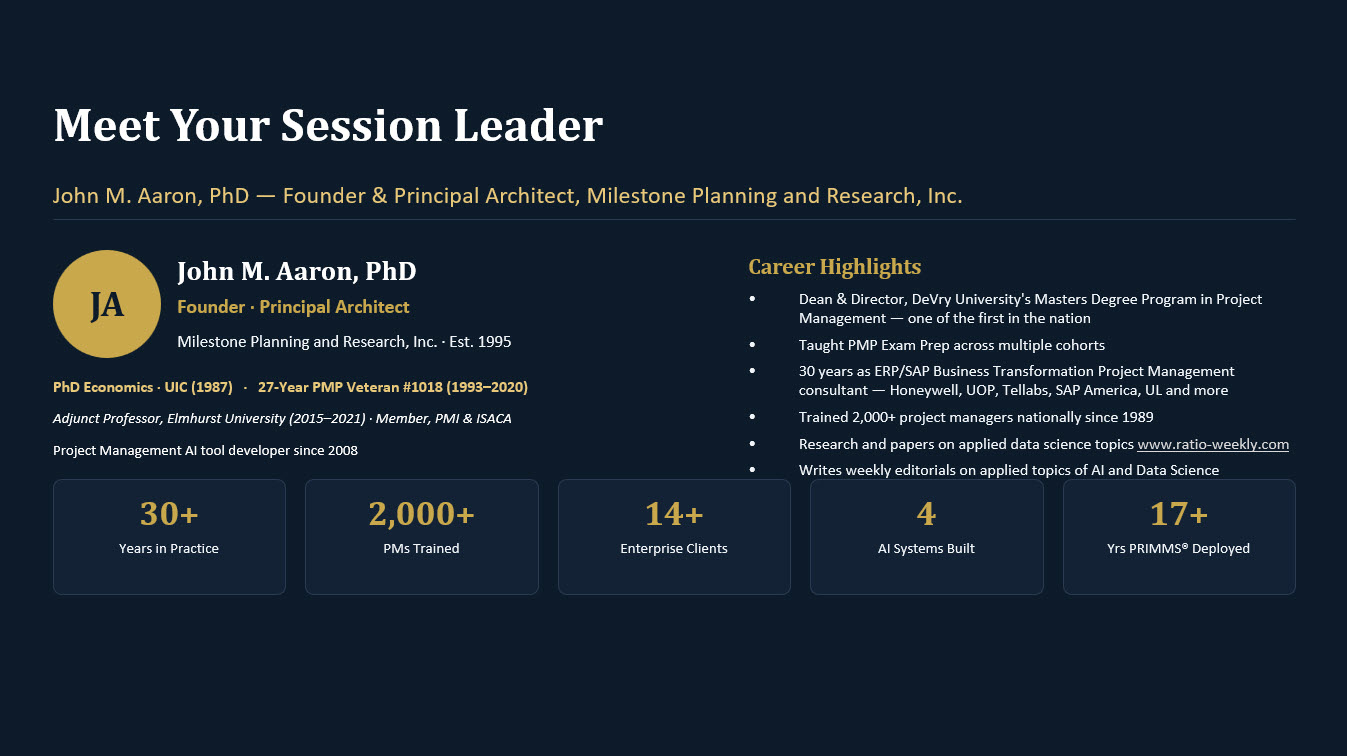
Presented by John Aaron, PhD · Milestone Planning and Research, Inc.
Apply for the Laboratory →
SESSIONS 1–2
Vision & The Laboratory
Identifying value propositions and use cases. Live tour of the enterprise AI stack — RAG, IUVO™ forecast engine, and PRIMMS-GPT.
SESSIONS 3–4
Design & Build
Quality gates from the start. PRIMMS-GPT and the AI project management discipline — milestone gates, human sign-off architecture.
SESSIONS 5–6
RAG & Validation
Live query against 783K headlines — bring your own question. The OCC-5C audit in practice. WoE verdict issued live.
SESSIONS 7–8
Agents, Deploy & Govern
Governed autonomy and delegation architecture. Deploying, sponsoring, and sustaining — from vision to competitive advantage.
COMPLIMENTARY FOR QUALIFIED EXECUTIVES · MICROSOFT TEAMS · BY REQUEST
AI Innovation With Trust Program · Release 6 · Trusted Innovation Capital
Not just workforce development.
Trusted innovation capability — built through structured practice.
The AI Innovation With Trust Program produces practitioners who can innovate responsibly with AI — demonstrating competency in real work, not just describing it. Its primary output is not a credential. It is a qualification card: the trust instrument that resolves the information asymmetry at the heart of the AI talent market. Five occupational pathways. Nine Common Trunk competencies including AI security awareness (T-2.7), AI-enabled innovation judgment (T-2.8), and AI-assisted decision quality (T-2.9). The Become stage builds the mentor/coach–practitioner thinking partnership that enables organizations to chart genuinely new AI pathways. Trust is the enabling condition. Innovation and competitive advantage are the returns.
📦
COMPLETE PROGRAM PACKAGE
All Program Documents
All six program documents — Prospectus, Occupational Standards Manual, Competency Methodology Guide, Employer Partnership Guide, College & University Partnership Guide, and Qualification Card & Signoff Standards — for all five occupational pathways in a single download.
↓ Download All Documents (.zip)
📄
WORKING PAPER
Trusted Innovation Capital
The full economic and theoretical foundation: Becker, Spence, Akerlof, the Trust ∝ 1/Risk axiom, the three-layer trusted innovation model, the TIC industry revealed-preference argument, and the augmented Cobb-Douglas production function with Lagrangian derivation. Appendix 2 ROI framework and Appendix 3 formal economics.
↓ Download Working Paper (PDF)
© 2026 Milestone Planning and Research, Inc. · All Rights Reserved · Employer, college, workforce board, and certification provider inquiries:
Current Research · Updated Fridays
RATIO Weekly Research
Empirical AI governance research from Milestone Planning and Research, Inc. — methodology, architecture, and evidence-based findings from active development programs.
New · June 2026 · Proof of Concept
Beyond Data Cleanup
Simulation, Trajectory Learning & Evidence Fusion · Five-Architecture Horse Race
A governance-first empirical study demonstrating that a B2B customer departure AI can be built without a single historical departure label — trained entirely on synthetic behavioral episodes. Five architectures evaluated against 175 customers, 156 weeks, locked ground truth. Best architecture: Sequential Fusion v2 (+$3,323k net economic value, $278k false positive penalty, 92% FPP reduction vs. surveillance-only). Completed in under one week of elapsed effort using Claude + ChatGPT under OCC 5C governance.
BEST NET VALUE
+$3,323k
Sequential Fusion v2
BEST AUC
0.858
LSTM+Fourier Hybrid
FALSE POS PENALTY
$278k
Fusion v2 · 92% reduction
ARCHITECTURES
5
Stata · MATLAB · Python
IUVO™ Forecast · Updated Fridays
IUVO™ S&P 500 Narrative Forecast
The IUVO™ S&P 500 narrative leading indicator — M7 ensemble model, EWI regime monitor, and analog analysis. An example of AI in production, audited under the OCC standard. Research and educational use.
EWI STATUS
NOT FIRED
4/10 🟡